
 COOPERATION · IHI · THERMAL POWER
SuperMRO and IHI: From surveys and 1D–3D simulation to combustion and heat-rate improvement
SuperMRO is an IHI partner for surveys, assessment and technical proposals for coal-fired power plants. The focus is combustion performance, opportunities to reduce heat rate and reliable operation. Cooperation starts with plant conditions, proceeds through analysis and modelling, and aims at verifiable operating results—not merely a calculation report.
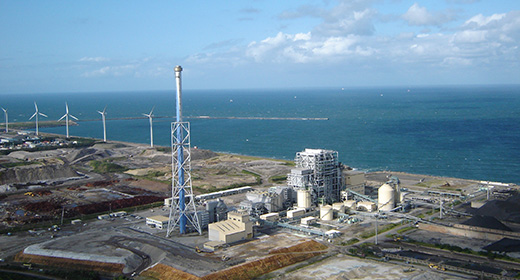
Power-boiler illustration from IHI; not a SuperMRO project.
Quick terminology
| Term | Explanation |
|---|---|
| Heat rate | Fuel energy per unit of electricity, commonly kJ/kWh or kcal/kWh. Specify gross/net output and higher/lower heating value. On a consistent basis, lower heat rate indicates higher efficiency. |
| 1D system model | Component/network representation for mass and energy balances and heat-transfer assessment. |
| 3D CFD | Computational Fluid Dynamics: spatial flow, thermal and combustion calculations, not simply a 3D drawing. |
| OFA | Overfire air: staged air above the burner zone; assess NOx, CO and burnout together. |
| FEGT / UBC | Furnace exit gas temperature / unburned carbon in ash. |
| Baseline / validation | Reference condition / checking model agreement and measured option performance. |
IHI and Steinmüller Engineering technology
IHI offers power boilers, fuel retrofits and lifecycle services. Steinmüller Engineering GmbH, an IHI Group company, specializes in combustion, heat transfer, consulting and digital tools. DimBo® is its thermodynamic boiler tool; ANSYS Fluent, RECOM-AIOLOS and EBSILON also appear in its digital portfolio. Tool selection, engineering entity and modelling scope are agreed for each project, not assumed to be included in every package. [1][2][3]
Define the plant problem before selecting software
Changes in fuel, moisture, fineness and load can affect combustion and heat absorption. Survey indicators include high UBC, difficult CO/NOx control, uneven gas/metal temperatures, slagging/fouling, attemperation demand and low-load constraints. These are assessment topics, not a diagnosis of every unit.
Review mills, pulverized-fuel distribution, primary/secondary air, burners, OFA, heating surfaces and APH together. Burner discussion here focuses on pulverized-coal boilers; CFB needs different modelling and criteria. Combustion efficiency, boiler efficiency and whole-unit heat rate are related but not identical.
1D and 3D CFD are complementary
1D establishes heat balances and compares system scenarios. The DimBo website describes steady-state calculation; transient requirements need an appropriate dynamic tool/scope. In a combined approach, 1D provides boundary conditions and thermal targets for CFD. [3]
3D CFD can examine swirl, mixing, particles, reactions and local heat transfer. Value depends on physical models, mesh, boundaries and validation, not image colours. 1D may suffice for screening; add CFD when spatial or detailed-design questions justify it. No universal mesh size or computation time applies. [2][4]
Plant staff can participate in using/developing 1D models with training, documentation and appropriate transfer/licensing agreements. Detailed combustion CFD requires specialists. Model or software handover is not automatic in every contract.
1D versus 3D CFD
| Criterion | 1D model | 3D CFD |
|---|---|---|
| Scope | Modelled boiler/system: gas, water/steam and relevant auxiliaries | Detailed furnace, burner or air/gas passage |
| Question | Where heat goes, surface absorption and fuel/load scenario effects | Where mixing, flow, hot spots and oxygen-deficient regions develop |
| Outputs | Heat balance, flows, temperatures, heat absorption and boundary conditions | Velocity/temperature fields, combustion, local heat flux and modelled emissions |
| Role | System assessment, scenario screening and detailed-analysis foundation | Root-cause investigation, burner/air design and option evaluation |
SuperMRO–IHI–plant delivery path
- 01 · Survey
Boiler records, fuel, load data and burner/heating-surface condition.
- 02 · Baseline
Measurements, data reliability and agreed metrics.
- 03 · Model
Task-specific 1D and 3D CFD, calibration and validation.
- 04 · Options
Technical/economic comparison, design and outage plan.
- 05 · Verify
Commissioning coordination, acceptance and follow-up.
Turn simulation into an implementable retrofit
Scenarios may include fuel/air distribution, burner balancing, OFA, nozzle geometry or fuel changes. NOx optimization must also check CO, UBC, flame stability, near-wall conditions and metal temperature; avoid exchanging one improvement for corrosion or overheating risk.
The public Herne Unit 4 reference combines 3D CFD with LowNOx burners, fuel distribution, OFA and commissioning. An IHI 2017 technical paper also describes CFD, model testing and firing-system modification. These are manufacturer-specific references, not SuperMRO projects or guaranteed results for Vietnamese plants. [4][5]
Biomass co-firing and conversion
Modelling can support fuel-change assessment, but conversion is not simply a nozzle or fuel-ratio change. Review receiving, storage, milling/drying, feeding, combustion properties, ash/alkali/chlorine, fouling/corrosion, heating surfaces and auxiliary demand. State whether co-firing ratios use energy or mass. IHI publicly develops co-firing/conversion solutions; suitability is unit-specific. [1]
Measure heat-rate improvement on a consistent basis
Agree gross/net heat rate, boiler efficiency, auxiliaries, NOx/CO, UBC, FEGT, metal temperature and load range. Before/after comparison needs correction or matched conditions for load, fuel, ambient conditions, equipment state and measurement reliability.
Assess fuel, auxiliary power, maintenance, outages and investment without double-counting fuel and heat-rate benefits. State model limits, uncertainty and guarantee responsibility. Neither a fixed saving percentage nor simulated results replace operating acceptance tests.
SuperMRO connects site needs to verified outcomes
Together with IHI, SuperMRO can support surveys, data review, baseline measurement, modelling, option evaluation, retrofit documentation and implementation coordination. SuperMRO translates operating needs into an engineering scope and coordinates records/outages; IHI and the appropriate technical entities provide analysis and design under the agreed scope. The plant validates data, approves changes and maintains safe operation.
Deliverables should include baseline, assumptions, validated model, option matrix, material/retrofit scope, acceptance criteria and monitoring plan. Specify any training, model transfer or post-retrofit support contractually. Industrial Trust is built through sound engineering and verified results, beyond an introduction to technology.