
 TECHNICAL NEWS · SEI EUROPE TECHNOLOGIE
Online furnace-gas temperature by sound: SEI Europe Technologie's ATS
A few thermocouple points or an average outlet value may conceal hot and cold regions across a furnace. SEI Europe Technologie's Acoustic Temperature System (ATS) uses sound paths through hot combustion gas to monitor the thermal field online. [1][2]
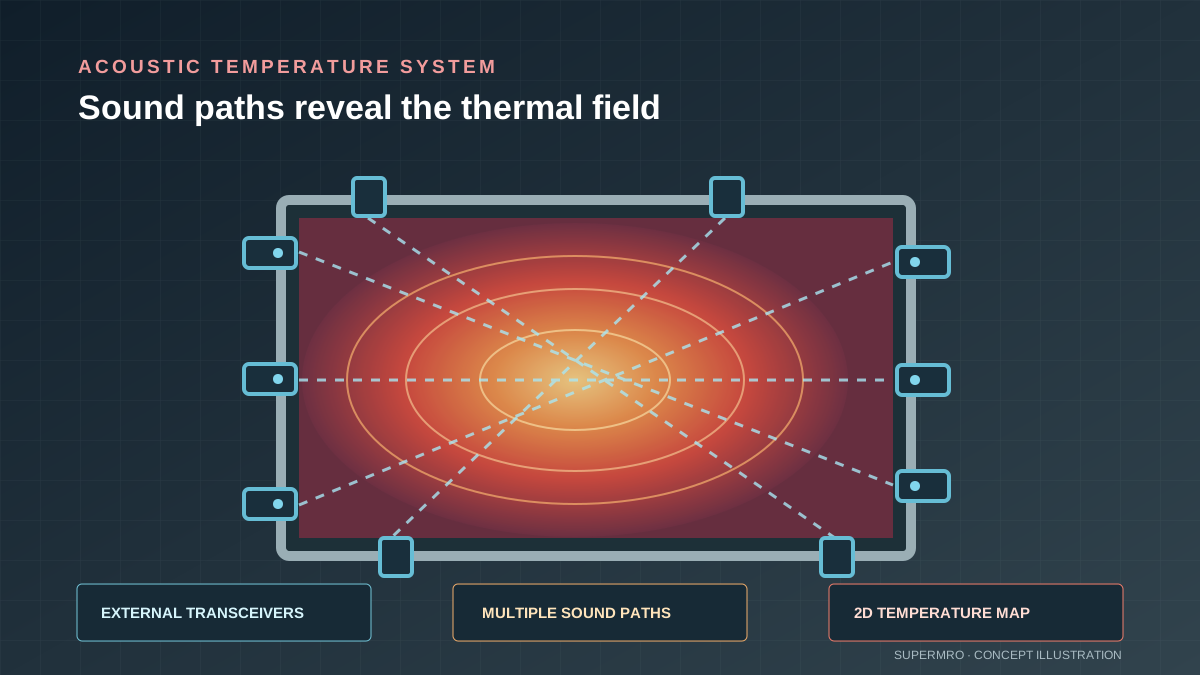
Concept illustration by SuperMRO based on SEI material; not a plant installation drawing.
How acoustic thermometry works
External transceivers send a high-intensity sound signal across the gas stream. Known path length and travel time yield the speed of sound and, with a gas model, a temperature estimate. For an approximately ideal gas of known composition, sound speed scales with the square root of absolute temperature. One path gives a path-integrated result, not a point temperature at its midpoint. [1][4]
From paths to a 2D thermal map
SEI describes independent paths and multi-path arrays across a plane, or a combination. Its CCU supports up to eight independent paths or an array of up to 24 paths for spatial mapping; actual layout depends on the furnace and purpose. Software shows individual paths, isotherms, user-defined zone averages, trends and history. The 2D image is reconstructed from finite paths, not a camera view of every point. [2][3]
Equipment and integration
The manufacturer describes a pneumatically driven acoustic source/receiver mounted outside the furnace wall for balanced-draft applications, a CCU and an industrial terminal with mapping software and configurable OPC outputs for DCS integration. External mounting avoids placing a probe deep in hot gas, yet measurement ports, waveguides, compressed air, cabling and maintenance access still require engineering review. Software also monitors furnace noise, but this is not a blanket leak-detection guarantee. [1][2][3]
A coal-power use case
At a selected furnace cross-section or exit-gas region, a thermal profile may reveal skewed hot zones and track changes with load, fuel, air or burner settings. Engineers can compare it with slagging, thermal stress and SNCR operating windows. These are diagnostic opportunities, not guaranteed NOx or fuel savings. Interpretation needs O₂, CO, NOx, mill and air/fuel distribution data. [1][3]
Other applications
SEI lists power stations, waste-to-energy and biomass, refinery and petrochemical heaters, glass factories and blast furnaces. Cement and other thermal-process furnaces should be treated as feasibility questions for a specific geometry and gas environment rather than claimed standard installations. [1][2]
Survey and acceptance
Define the measurement plane, dimensions, ports and usable sound paths across load conditions. Review background noise, dust, gas flow/composition, compressed air, temperature, vibration and DCS interfaces. Validate at more than one load and fuel condition, including missing-path behavior and map quality. ATS temperature diagnostics do not replace a protective flame-presence scanner. [2][3][4]
SuperMRO perspective
SuperMRO can help a plant define its thermal visibility gap, assemble drawings and data, coordinate manufacturer/specialist assessment and set integration and acceptance criteria. This editorial review uses SEI's public information; it does not claim an implemented project or distribution agreement. Performance should be verified on the actual unit.