
 TECHNICAL NEWS · EUTECH GERMANY
EUtech: online air flow, coal fineness and furnace-temperature insight for coal-fired boilers
Stack O₂ or NOx shows an outcome, but not always whether the underlying cause is uneven air, mill/classifier performance or an asymmetric temperature field. Aachen-based EUtech Scientific Engineering offers complementary diagnostics at these three points. [1][2]
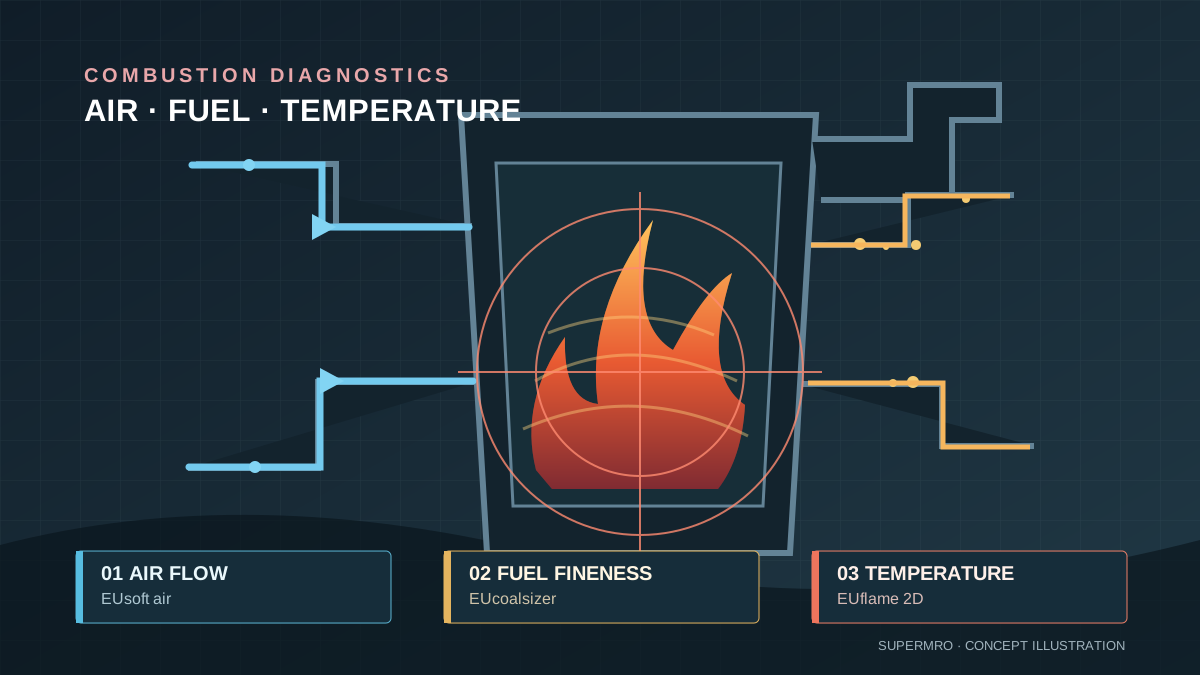
Conceptual illustration by SuperMRO based on EUtech sources; not a plant engineering drawing.
Three questions, one combustion picture
A burner needs air in proportion to its fuel and particle properties, at the right location. Coarse or uneven fuel can change burnout and flame behavior; thermal imbalance can matter for slagging, heat stress and SNCR. No single signal proves root cause. Air, fineness and temperature should be compared at similar load and fuel conditions. [2]
EUsoft air: virtual measurement from plant signals
The physics-based virtual sensor uses existing DCS process data to calculate air flows across the air path and at relevant burner locations. EUtech describes DCS integration and the potential to flag sensor faults and air leakage with limited extra hardware. Its quality still depends on input data, a plant-specific model and field validation; it is not an automatic substitute for safety instrumentation. [1][3]
EUcoalsizer: particle size while the mill is running
An insertable laser probe determines the particle-size distribution within a measuring volume in the pulverized-fuel pipe. The product material also describes velocity and temperature readings and continuous or survey use. Online results help compare pipes and assess mill/classifier changes under varying loads and coals. A published 660 MWe case observed changes in the fraction below 75 µm and burner-to-burner distribution as classifier speed changed; its figures are not a plant-wide performance guarantee. [4][6]
EUflame 2D: a temperature field, not one point
An optical system profiles critical furnace temperatures in two dimensions, including furnace-exit gas temperature (FEGT) in suitable configurations. It can reveal hot spots and imbalances and inform SNCR temperature-window assessment, in stationary or mobile deployments. It is a diagnostic temperature map, not the burner flame-presence detector in a protection circuit. Sight lines, dust, installation and validation must be assessed on site. [1][5]
From measurement to a controlled test
Establish comparable load and fuel baselines; review air distribution, fineness behind the mills and pipe-to-pipe variations; compare the thermal map with O₂, CO, NOx, unburned carbon and deposit history. Then change one relevant setting at a time and verify before/after. EUcoalflow is a separate module for coal mass flow and velocity by pipe; it should not be confused with EUcoalsizer's fineness analysis. [1][2]
Where it fits
The strongest fit is a multi-mill, multi-burner coal unit with changing fuel quality or load. Biomass, waste-to-energy and other thermal applications may use selected modules only after fuel- and plant-specific assessment. An initial survey needs air and coal-line drawings, measurement ports, DCS signal lists, operating history and acceptance criteria. Mobile diagnosis can precede permanent monitoring. [2]
SuperMRO perspective
SuperMRO can help plant teams define symptoms, available data, measurement gaps and a test scope, then coordinate specialist/manufacturer assessment, integration and validation as appropriate. This is an editorial introduction based on EUtech's public material, not a claim of an implemented project or distributorship. Results must be demonstrated on the unit itself.